-
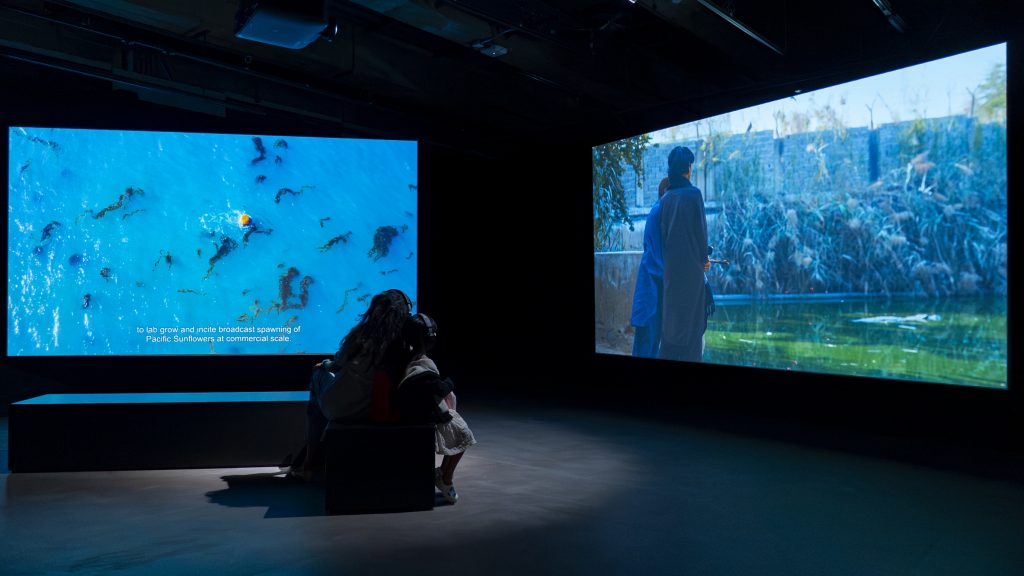
Installation view, Skin of Dreams, Cultural Foundation, Abu Dhabi, 2026.
Photography © Department of Culture and Tourism - Abu Dhabi.
EXHIBITION
Skin of Dreams
Skin of Dreams invites you into the richly textured universe Shezad Dawood has been shaping for over decades. Anchored in research, his works draw on diverse references from history, literature, architecture, music, science and technology, allowing him to make fantastical connections and leaps we might otherwise miss.
The exhibition’s title, Skin of Dreams, is a phrase used to describe the cinema screen, conjuring the boundary between imagination and reality. Conceived in dialogue with Cultural Foundation’s unique architecture, the exhibition responds to the building’s blend of Bauhaus clarity and Islamic geometric patterns, attending to light, proportion and integrated ornaments.
Curated by Jessica Cerasi, it brings together over 40 works including painting, sculpture, monumental film installations, and interactive virtual reality experiences.
Dawood’s Leviathan Cycle film series is set several decades into the future, with each episode a snapshot into how climate change and scientific developments may have affected life on Earth. Newly completed, the final two episodes are presented at the Cultural Foundation for the first time.
Set in South Korea, Episode 9: Hye Yeon, Nemo & Ding Ling, explores the ethical ramifications of using genetic engineering and artificial intelligence to preserve biodiversity and keep delicate ecosystems in balance. It posits that marine science can have medical implications for humans, resulting in new and unexpected evolutionary pathways.
Filmed in Dawood’s home city of Karachi, Episode 10: Encroachments – Ben, Tariq & Amina takes pace in what remains of South Asia after the world has ended more than once. A dreamlike and psychedelic sequence of events blends past, present and future. Recounted through the prism of folk tales drawn from the fishing communities of Sindh, it imagines how humans might merge with the sea.
Over the years, Leviathan Cycle has traced speculative ecological futures mapping the urgent crises and intersection of climate change, shifting borders, and marine environments. To date, the cycle’s immense scale has been recognised through presentations at more than 20 international institutions and 5 international biennials, as well as film festivals and screening programmes. While the series now reaches its finale, its evolving narratives continue to invite viewers to speculate on our collective futures.
Click here for more information on the exhibition.